

What makes a Lake Manyara safari memorable may be the changing landscape as much as any single animal sighting. The park’s groundwater forest, acacia woodland, lakeshore and Rift Valley escarpment create a varied setting where elephants, giraffes, baboons and birdlife may come into view. Tree-climbing lions are part of its reputation, but wildlife encounters are never guaranteed.
To decide whether Lake Manyara belongs in your Tanzania plans, consider which habitats you want to experience, what wildlife interests you and how much time you have. This guide explains how the park’s landscapes shape viewing, what to expect from sightings and how to plan a visit that fits into a wider safari.
Lake Manyara can complement other destinations, whether you’re planning a short safari or a longer journey. A thoughtful itinerary balances your interests and available time with realistic expectations and respect for wildlife and local communities.
Key Takeaways
- A Lake Manyara safari is shaped by its changing habitats and viewing conditions, not by a guaranteed wildlife encounter.
- Choose your priorities, such as forest scenery, lakeside birdlife or a broad wildlife introduction, to set realistic expectations.
- Tree-climbing lions are part of the park’s reputation, but seeing one is never guaranteed.
- Consider your interests, travel dates and available days when deciding whether Lake Manyara fits your Tanzania journey.
- Lake Manyara can complement other destinations in a safari planned around your preferred travel style.
What Makes a Lake Manyara Safari Distinctive?
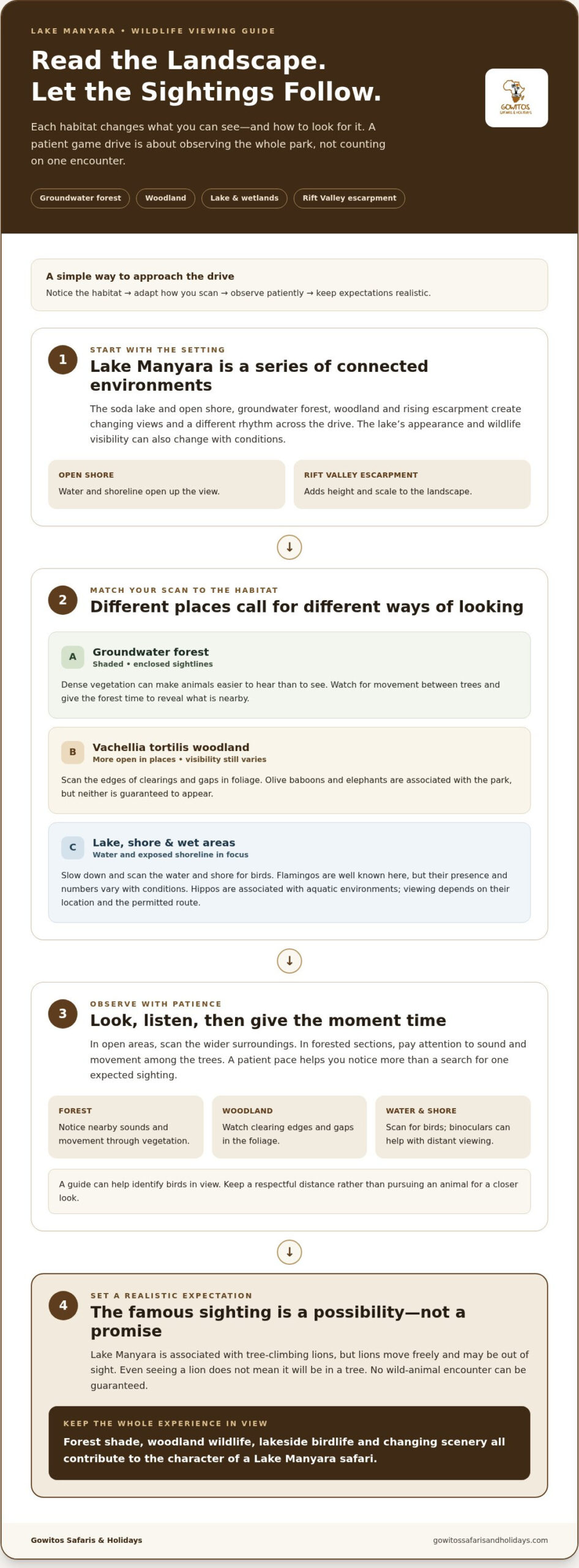
A Lake Manyara safari takes you through a varied landscape, from the soda lake and open shore to woodland, groundwater forest and the rising Rift Valley escarpment. Each habitat offers a different perspective, so the experience is not centred on one expected sighting. The lake’s appearance and wildlife visibility can also change with conditions.
Habitat variety, more than any single animal encounter, defines the character of Lake Manyara.
Where Lake Manyara National Park Sits in a Tanzania Safari
Lake Manyara National Park can add a distinct landscape to a journey that includes other parks. Consider how its lakeshore and forest scenery would complement places such as Tarangire or Ngorongoro, rather than treating every stop as a search for the same wildlife. The park’s geography, wildlife and administration are outlined in this Lake Manyara National Park overview.
The 3 Days Tarangire, Ngorongoro & Manyara itinerary brings Lake Manyara into a compact safari plan. Whether that combination suits you depends on what you want to experience and how much time you have. Adding destinations simply to make an itinerary longer does not necessarily make it a better fit.
A Landscape That Changes Across the Park
Near the alkaline lake, water and shore create an open view. In the groundwater forest, shade and vegetation enclose the drive and limit sightlines. The escarpment rises above these settings, adding a sense of height and scale. The lake, woodlands, forest and escarpment are also central features in the park’s geographic overview.
These contrasts change the rhythm of a game drive. In open areas, scan the wider surroundings; in forested sections, pay attention to movement and sound among the trees. Wildlife may be resting out of sight, and visibility varies, so allow time to observe instead of measuring the visit by a particular encounter.
For a first visit, think of Lake Manyara as several connected environments rather than one uniform safari landscape. If you’re interested in scenery, birdlife or the contrast between forest and lakeshore, that variety may matter as much as the larger animals you hope to see.
How Lake Manyara’s Habitats Shape Wildlife Viewing
Wildlife viewing is easier to understand when you consider where animals spend time. The lakeshore, wet areas, forest and woodland each create different viewing conditions. Waterbirds are associated with the lake environment, while dense vegetation can make animals easier to hear than to see. Moving patiently through more than one habitat can give you a broader impression of the park.
Lake Manyara’s varied habitats create varied wildlife-viewing opportunities, but they don’t promise a particular sighting. The Tanzania Tourism Board’s Lake Manyara destination overview describes the park’s ecosystems and birdlife, useful context for understanding why the landscape matters as much as an animal checklist.
Forest and Woodland Encounters
The groundwater forest and vachellia tortilis woodland offer contrasting settings. Under the forest canopy, thick vegetation limits long views, so you may notice nearby sounds or movement between trees before you see an animal clearly. Woodland is more open in places, although visibility still depends on foliage and where wildlife happens to be. Olive baboons and elephants are among the animals associated with the park, but neither is guaranteed to appear.
Adjust how you scan the landscape: watch the edges of clearings and gaps in vegetation, and give yourself time to notice what emerges. In a Lake Manyara safari, the forest can feel close and shaded, while woodland may offer wider sightlines. Both reward attentive observation.
The Lake, Wetlands, and Birdlife
At the lake and surrounding wet areas, water and exposed shore become the focus. Flamingos are among the park’s best-known birds, but their presence and numbers can vary with conditions. Other waterbirds may also appear around wetland habitats. Hippos are associated with aquatic environments, though a sighting depends on where they are and what can be viewed safely from the permitted route.
For birdwatching, slow down and scan the water and shoreline. Notice where birds gather, feed or move between wet areas. Binoculars can help you observe distant birds without approaching them, and a guide can help identify what is in view. Keep a respectful distance rather than pursuing an animal for a closer look.
If forest shade, woodland wildlife or lakeside birdlife is a priority, use that interest to shape your itinerary. Explore a tailored Tanzania safari planned around your interests, available time and preferred travel style.
Are Lake Manyara’s Tree-Climbing Lions Guaranteed?
No. Lake Manyara’s reputation for tree-climbing lions makes the possibility intriguing, but it does not make a sighting predictable. Lions move freely through their habitat, and visibility depends on where they are and the conditions at the time. A visit can still be rewarding if you don’t see a lion in a tree.
No wild-animal encounter can be promised. That applies to lions and every other species in the park. Enjoying what unfolds, rather than judging the drive by one famous sighting, makes room for the full range of experiences.
Why the Tree-Climbing-Lion Reputation Draws Attention
Lake Manyara is associated with lions that climb trees, a behaviour highlighted among the park’s attractions by the Tanzania Tourism Board’s Lake Manyara overview. It is an unusual possibility to look out for, not a behaviour you can expect every lion to display or a scene certain to appear on a particular drive.
Even if you see a lion, it may be resting or moving through the landscape rather than perched above the ground. Vegetation can obscure animals, and some may simply be out of view. The park’s reputation can suggest what to watch for, but it cannot predict what wildlife will do during your visit.
What to Expect When Wildlife Is Unpredictable
Give your attention to the whole drive. Watch for movement near the track, notice changes in the vegetation and listen to your guide’s observations. A quiet stretch still offers a chance to take in the landscape; another may bring an unexpected encounter. Patience can help when visibility is limited, but it cannot guarantee a particular result.
It helps to have more than one interest. You might hope to see a lion while also appreciating the birds, forest and open lakeside views. This broader perspective makes a Lake Manyara safari less dependent on one headline species and more responsive to what each drive offers. Wildlife viewing means observing animals in their surroundings, not directing their behaviour for a photograph.
Follow your guide’s instructions and keep a respectful distance. Avoid encouraging animals to move or gathering too closely around a sighting. Calm observation supports a safer, more considerate experience for visitors and wildlife. If lions are high on your list, treat them as a hope, not a promise, and stay open to other moments along the way.
How to Plan a Lake Manyara Visit Around Your Interests
Start with what you hope to notice, then allow for changing wildlife and viewing conditions. Instead of building the visit around one animal, decide which parts of the experience matter most and let those priorities guide the pace. For a Lake Manyara safari, use this planning sequence:
- Choose your focus. Decide whether birds, landscapes, photography or a broad introduction to wildlife matters most.
- Consider timing. Take your travel dates and changing conditions into account, without treating a particular season as a promise of specific sightings.
- Set expectations. Keep your interests in mind, while staying open to what is actually visible during the visit.
- Plan the wider journey. Consider how Lake Manyara fits alongside parks such as Tarangire or Ngorongoro, given your available time and preferred travel style.
This turns a general wish to “see wildlife” into a more personal plan. It also encourages responsible choices: observe from appropriate places, respect wildlife and follow your guide’s instructions.
Choose a Visit Focus Before You Travel
Think about the experience you’d most enjoy. Bird enthusiasts may want time at the lake and wetland edges; landscape-minded travellers may value the changing views between shore, woodland and forest. If photography is a priority, decide whether you prefer broad scenery or close observation, while remembering that animals don’t arrange themselves for a picture.
Your focus can shape the pace without locking the visit into a rigid schedule. If you’re travelling with others, share priorities beforehand to balance different interests. A broad introduction may suit those who want to experience several habitats, while a focused visit can leave more time to observe one setting.
Set Timing and Wildlife Expectations
Conditions change, and visibility depends on factors such as vegetation, water and animal movement. Treat seasonal descriptions as planning context, not a guarantee that a particular species will appear. For date-specific conditions and visitor guidance, use current, authoritative Tanzania tourism or park information rather than relying on a general seasonal promise.
Consider the wider journey before settling on dates. If you’re weighing Lake Manyara alongside Tarangire and Ngorongoro, compare what draws you to each park and how much time you have. There is no fixed route that suits every traveller. A tailored itinerary can bring your interests and travel style together while keeping respect for wildlife in view.
Plan a tailored Tanzania safari around the landscapes and wildlife experiences you most want to explore.
How Lake Manyara Can Fit into a Tailored Tanzania Safari
Lake Manyara can add a distinctive stop to a multi-park journey, but it does not need to feature in every traveller’s plans. Consider how its lakeside and forest landscapes would complement the other places you hope to visit, then weigh that against your available time, interests and preferred pace. A well-shaped itinerary gives each destination a purpose rather than simply listing parks.
For some travellers, a Lake Manyara safari brings a different landscape into a journey that also includes Tarangire or Ngorongoro. Others may prefer to focus their time elsewhere. The useful question is what you want the journey to feel like, and whether adding another park supports that intention.
Decide What You Want from a Multi-Park Journey
Before choosing destinations, consider what matters most: landscape variety, particular wildlife interests, a relaxed pace or the chance to experience several parks. Then compare those priorities with your available time and what each stop would contribute. More destinations can offer a broader range of settings, while a simpler plan may give you longer in the places that matter most.
If you’re considering Ngorongoro, crater-specific logistics and context are a separate part of planning. A practical guide to Ngorongoro Crater can help you understand that destination on its own, while leaving this decision focused on how it fits your wider journey.
Continue Planning with a Personal Touch
Gowitos Safaris & Holidays plans Tanzania journeys around travellers’ interests, available time and preferred travel style. Its 3 Days Tarangire, Ngorongoro & Manyara itinerary is one example of how Lake Manyara can fit into a multi-park plan. The itinerary combines those destinations; the planning decision is whether that combination suits the experience you want.
As you shape your route, consider not only what you hope to see, but how you want to travel. A thoughtful plan can leave room for unhurried observation and choices that respect wildlife. Responsible travel also considers the people connected to the places you visit, with local benefit as part of the journey’s value.
Share your interests, time frame and preferred style with Gowitos Safaris & Holidays to shape a personal Tanzania safari and decide whether Lake Manyara belongs in your route. Explore a tailored Tanzania safari as you begin planning.
Shape a Safari That Feels Like Yours
Turn the places that interest you into a journey with a comfortable rhythm. Consider what you’d like to spend time noticing, how much variety you want between stops and what pace will let you be present along the way. These choices can help you decide whether a Lake Manyara safari belongs in your plans, without making one wildlife sighting the measure of the experience.
A meaningful Tanzania journey leaves room for curiosity as well as careful planning. Gowitos Safaris & Holidays creates trips around travellers’ interests, available time and preferred travel style, with respect for wildlife and benefit to local people as part of responsible travel.
Ready to explore a route that reflects what matters to you? Explore a tailored Tanzania safari with Gowitos and start planning a journey that feels thoughtfully your own.
Frequently Asked Questions
Is Lake Manyara suitable for a first safari?
Yes. Lake Manyara can make an engaging introduction to safari, especially if you’re curious about varied scenery as well as wildlife. Its different settings offer plenty to notice during a drive, and a guide can help explain what you’re seeing. Consider whether you prefer a relaxed pace or a fuller itinerary, and treat the park as one part of Tanzania’s wider natural story, not a checklist of guaranteed sightings.
How much time should I allow for a Lake Manyara safari?
There is no single ideal duration for every traveller. The time you spend at the park depends on your interests, how it fits into the wider itinerary and whether you prefer a leisurely or compact pace. Allow enough time to appreciate the surroundings and observe wildlife without feeling hurried. Some flexibility helps, since each visit can unfold differently.
What should I pack for a Lake Manyara safari?
Pack comfortable, neutral-coloured clothing, sun protection, insect repellent, drinking water and binoculars. A small day bag keeps essentials together and easy to reach. Adapt your choices to current conditions and the wider itinerary, since your needs may vary with the plans for the day. This is general preparation, not a park-mandated equipment list; your guide can provide context for the day’s plans.
Can I take photographs during a Lake Manyara safari?
Yes. What you can capture depends on visibility, distance and animal behaviour. Keep your camera ready without letting it distract you from the surroundings. Follow your guide’s directions, remain at a respectful distance, and avoid calling, approaching or otherwise disturbing wildlife for a photograph. Some moments are better enjoyed without a camera, and no close encounter or particular image can be promised.
Is Lake Manyara worth visiting if I am more interested in landscapes than big cats?
It may be, since the park’s appeal includes the lake, woodland, forest, wetlands and escarpment as well as big cats. Which features you see can vary, so approach the visit with curiosity rather than a fixed expectation. If you enjoy noticing how scenery changes during a drive, consider whether that variety suits your interests. A big-cat sighting does not have to be the measure of a rewarding visit.
What happens if I do not see the wildlife I hoped for?
That can happen: wild animals move freely, and sightings aren’t guaranteed. Rather than focusing only on one hoped-for species, stay attentive to the surroundings, including birdlife, smaller details and changes in the landscape. Your guide’s direction can help you make the most of what’s visible while keeping wildlife undisturbed. Flexibility is part of a responsible safari; it cannot promise a particular substitute encounter, but it can help you stay present throughout the visit.
