
Lake Manyara National Park is one of northern Tanzania’s most varied wildlife destinations. Set below the dramatic Great Rift Valley escarpment, the park combines groundwater forest, acacia woodland, open grassland, wetlands and the alkaline lake within a relatively compact area.
The park is known for its elephants, large baboon troops, varied birdlife and lions that may occasionally rest in trees. Its changing habitats make it an excellent destination for first-time safari visitors, families, birdwatchers and travellers combining several Northern Circuit parks.
Lake Manyara can be visited on a day trip from Arusha or included in a longer safari with Tarangire, Serengeti and the Ngorongoro Crater.
Gowitos Safaris & Holidays arranges private and group safaris to Lake Manyara, including transportation, professional guides, park fees and accommodation.
Why Visit Lake Manyara National Park?
Lake Manyara provides a different experience from the open plains of Serengeti and the dry woodland of Tarangire.
Within one game drive, visitors can pass through dense forest, woodland, grassy floodplains and wetland habitats. These environments support primates, elephants, buffaloes, giraffes, zebras, antelopes and numerous birds.
The park is also conveniently located near Mto wa Mbu and Karatu, making it easy to include in short and extended Northern Circuit itineraries.
7 Amazing Lake Manyara Safari Highlights
1. The Great Rift Valley Escarpment
The steep Great Rift Valley escarpment forms a dramatic background to Lake Manyara National Park.
The escarpment rises above the forest and lake, creating impressive views from different parts of the park. Its height and rugged slopes help give Lake Manyara a distinctive landscape.
Visitors travelling from Arusha descend through the Rift Valley region before reaching Mto wa Mbu and the park entrance.
The escarpment is especially beautiful during the wetter months when vegetation becomes green and waterfalls may appear along some sections.
2. Groundwater Forest
Visitors entering Lake Manyara National Park pass through a lush groundwater forest.
Underground water flowing from the escarpment supports tall trees, thick vegetation and shaded pathways. This forest creates a noticeable change from the drier countryside outside the park.
Blue monkeys, vervet monkeys and baboons may be observed within the forest. Elephants and bushbucks also move through the shaded environment.
The dense vegetation can make wildlife more difficult to photograph, but patient observation often reveals animals between the trees.
3. Large Baboon Troops
Lake Manyara is well known for its baboons. Large troops may be encountered along roads, within the forest and around open areas.
Visitors may observe baboons feeding, grooming, carrying young or interacting with other members of the troop.
Although they may appear comfortable around vehicles, baboons remain wild animals. They should never be fed or approached.
Food must remain secured inside the safari vehicle, particularly at picnic sites.
4. Elephants
Elephants are one of the major attractions in Lake Manyara National Park.
They are frequently found around the groundwater forest, woodland and other areas containing suitable vegetation and water.
Family groups may include adult females, younger animals and calves. Mature males may be seen alone or in small groups.
The forest creates opportunities to observe elephants at relatively close range, but your driver-guide must maintain a safe distance and avoid blocking their path.
5. Tree-Climbing Lions
Lake Manyara is historically associated with lions resting in trees. The exact reason for this behaviour is uncertain and may involve avoiding insects, finding shade or gaining a better view.
However, tree-climbing lions should not be treated as a guaranteed sighting. Lions move naturally and may remain hidden in woodland or tall grass.
Visitors should appreciate the park’s wider wildlife rather than judging the entire safari by whether a lion is found in a tree.
6. Flamingos and Waterbirds
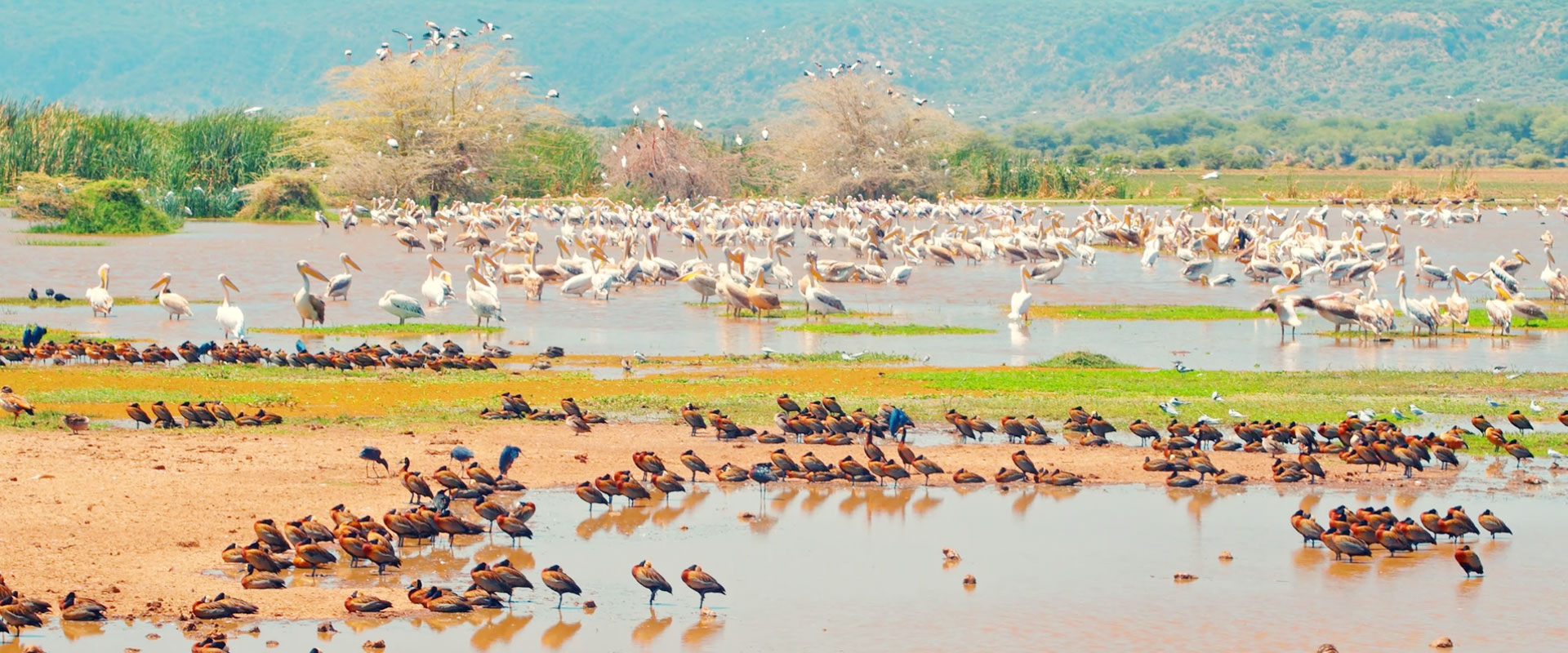
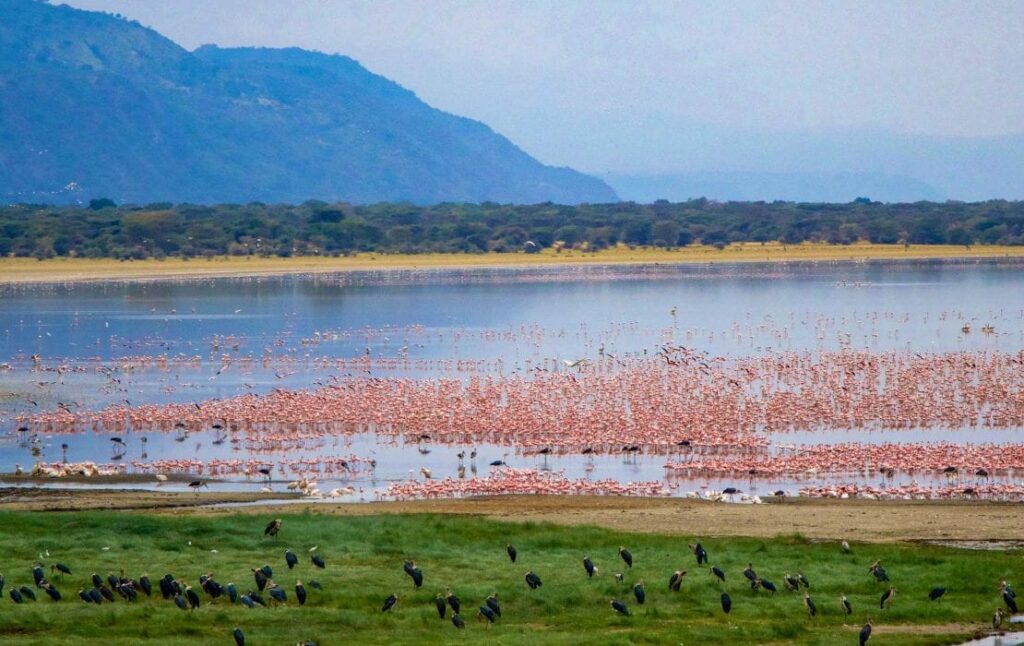
The lake and surrounding wetlands support a wide range of birds.
Flamingos may be present when water depth, salinity and food conditions are suitable. Their numbers change naturally, and large concentrations are not guaranteed throughout the year.
Other birds may include:
- Pelicans
- Storks
- Herons
- Egrets
- Cormorants
- Kingfishers
- Fish eagles
- Hornbills
- Bee-eaters
- Weavers
- Crowned cranes
- Birds of prey
The park’s different habitats make it suitable for both experienced birdwatchers and visitors beginning to develop an interest in birds.
7. Diverse Landscapes in a Compact Park
Lake Manyara’s varied landscape is one of its greatest strengths.
A single game drive may pass through:
- Groundwater forest
- Acacia woodland
- Open grassland
- Wetlands
- River channels
- Hot springs
- Lakeshore habitats
- Rocky escarpment scenery
This environmental variety makes the park feel larger and more diverse than its road network may suggest.

Wildlife in Lake Manyara National Park
Lions
Lions live within the park but can be difficult to locate because of dense vegetation and changing wildlife movement.
They may be found resting in grass, woodland or occasionally trees. Every sighting depends on patience and favourable timing.
Elephants
Elephants are among the animals most commonly associated with Lake Manyara. They often move through forested areas and woodland.
Buffaloes
Buffaloes may be seen grazing on open plains, resting near water or moving between grassland and forest.
Giraffes
Giraffes feed around acacia woodland and open areas. Their height makes them relatively easy to see when vegetation is not too dense.
Zebras and Wildebeests
Zebras and wildebeests may be observed on open floodplains and grassland. Their numbers and distribution change with season and water levels.
Hippos
Hippos live in suitable pools and waterways. Visitors may see them resting in water during the day.
Hippos are powerful and potentially dangerous animals. They must always be observed from authorised areas and a safe distance.
Antelopes
Possible antelope sightings include:
- Impalas
- Waterbucks
- Bushbucks
- Dik-diks
- Klipspringers
- Common duikers
The exact species encountered depend on habitat and season.
Primates
The groundwater forest supports:
- Olive baboons
- Blue monkeys
- Vervet monkeys
Primates should never be fed, even when they approach vehicles or picnic areas.
Lake Manyara’s Changing Water Levels
Lake Manyara is a shallow alkaline lake whose size and appearance change according to rainfall, evaporation and water flowing from the surrounding highlands.
During wetter periods, the lake may expand across parts of the floodplain. Changes in water levels can affect roads, bird distribution and wildlife movement.
During drier conditions, exposed lakeshore areas may provide feeding grounds for herbivores and birds.
These natural changes mean that the park does not look exactly the same during every visit.
Birdwatching
A Lake Manyara National Park safari is an excellent choice for birdwatchers.
The groundwater forest supports forest species, while the lake and wetlands attract waterbirds. Grassland and woodland provide habitats for raptors, hornbills, rollers and ground-dwelling birds.
Visitors interested in birdwatching should inform Gowitos Safaris & Holidays before travelling. A private safari allows more time to stop and identify species without following a fixed group schedule.
Binoculars and a camera with a suitable telephoto lens are recommended.
Safari Activities
Game Drives
Game drives are the principal activity in the park. They may be arranged in the morning, afternoon or throughout the day.
The driver-guide selects routes according to wildlife movement, weather and road conditions.
Birdwatching
Birdwatching can be included during a normal game drive or arranged as a special interest activity.
Photography
The escarpment, forest, lake and wildlife provide varied photography opportunities.
Dense forest may require higher camera settings, while the open lake area provides stronger natural light.
Night Game Drives
Night game drives may be available through authorised operators and accommodation providers. They require advance booking and are not automatically included in a standard safari.
Treetop Walkway
A canopy or treetop walkway experience may be available near the park entrance under authorised arrangements.
The activity is optional and should be requested in advance. Availability, operating conditions and additional charges must be confirmed.
Cultural Experiences
Mto wa Mbu offers cultural walks, local food experiences, cycling and community activities. These take place outside the national park and must be booked separately.
Best Time to Visit Lake Manyara National Park
The park remains open throughout the year, but each season provides a different experience.
June to October
These are generally the drier months. Wildlife may gather near permanent water sources, while vegetation becomes less dense in some areas.
This period is popular for Northern Circuit safaris, so early reservations are advisable.
November and December
Short rains refresh the vegetation and encourage bird activity. The landscape becomes greener, and migratory species may arrive.
January to March
This period is generally warm, with green scenery and good birdwatching conditions.
Wildlife remains present but may be distributed across a wider area because of available water.
April and May
The long rains create lush forest and escarpment scenery. Some roads may become muddy or inaccessible after heavy rain.
Visitor numbers may be lower, making this period suitable for travellers who prefer quieter conditions.
Lake Manyara Day Trip from Arusha
Lake Manyara can be visited on a full-day trip from Arusha.
The standard programme normally includes:
- Morning hotel pickup
- Drive through the Great Rift Valley region
- Park entrance formalities
- Guided game drive
- Picnic lunch
- Afternoon wildlife viewing
- Return to Arusha
The journey generally takes approximately two to three hours in each direction, depending on traffic and road conditions.
A day trip is suitable for travellers with limited time. Visitors joining a longer safari can spend the night around Mto wa Mbu or Karatu before continuing to another destination.
How Many Days Should You Spend at Lake Manyara?
One Day
One full day is normally enough for a general introduction to the park.
Two Days
Two days provide more time for birdwatching, photography and optional activities in Mto wa Mbu.
Combined Safari
Lake Manyara is commonly included as one day within a longer itinerary covering Tarangire, Serengeti and Ngorongoro.
The ideal duration depends on your interests, travel time and safari budget.
Where to Stay
Accommodation is available near the park, around Mto wa Mbu, on the Rift Valley escarpment and towards Karatu.
Budget Accommodation
Budget options may include simple lodges, guesthouses and campsites.
Mid-Range Lodges and Camps
Mid-range properties generally provide comfortable rooms, private bathrooms and meal services.
Luxury Accommodation
Luxury lodges may offer escarpment views, spacious rooms, swimming pools and upgraded dining.
Accommodation Inside or Near the Park
Selected properties offer convenient access to the park. Availability and price vary by season.
The exact accommodation will be confirmed before booking.
How to Reach Lake Manyara National Park
From Arusha
Most visitors travel by road from Arusha. The route passes through Makuyuni and descends towards Mto wa Mbu.
From Tarangire
Lake Manyara can be combined with Tarangire in a two-day safari. Driving time depends on the exact accommodation and route.
From Ngorongoro and Karatu
The park is easily reached from Karatu, making it suitable before or after a Ngorongoro Crater safari.
By Air
Flights may operate to an airstrip serving the Lake Manyara area. Schedules and baggage restrictions should be confirmed before travel.
Combining Lake Manyara with Other Destinations
Lake Manyara can be combined with:
- Tarangire National Park
- Ngorongoro Crater
- Serengeti National Park
- Arusha National Park
- Lake Eyasi
- Mto wa Mbu
- Mount Kilimanjaro
- Mount Meru
- Zanzibar
Popular itineraries include:
- Two days in Tarangire and Ngorongoro
- Three days in Lake Manyara, Ngorongoro and Tarangire
- Four days in Tarangire, Serengeti and Ngorongoro
- Five days in Lake Manyara, Tarangire, Serengeti and Ngorongoro
What to Pack
Recommended items include:
- Comfortable neutral-coloured clothing
- Warm jacket for early mornings
- Closed shoes
- Sun hat
- Sunglasses
- Sunscreen
- Insect repellent
- Camera
- Spare batteries
- Memory cards
- Binoculars
- Personal medication
- Small day bag
- Passport or identification
- Light rain jacket
- Chargers and power bank
- Reusable water bottle where appropriate
Soft-sided luggage is generally more practical for safari vehicles and domestic flights.
Responsible Safari Guidelines
Visitors should follow park rules and the instructions of their driver-guide.
Responsible behaviour includes:
- Remaining on authorised roads
- Keeping a respectful distance from wildlife
- Never feeding animals
- Avoiding excessive noise
- Not calling animals for photographs
- Keeping rubbish inside the vehicle
- Remaining inside the vehicle except at authorised places
- Not approaching baboons or monkeys
- Respecting other visitors
- Avoiding damage to vegetation
Wildlife welfare and safety must take priority over photographs.
Frequently Asked Questions
Where is Lake Manyara National Park?
The park is located in northern Tanzania beneath the Great Rift Valley escarpment, near Mto wa Mbu.
What is Lake Manyara famous for?
It is known for diverse habitats, elephants, baboons, birdlife and lions that may occasionally rest in trees.
Are tree-climbing lions guaranteed?
No. Lions move naturally and may remain hidden in forest, woodland or grassland.
Is Lake Manyara suitable for a day trip?
Yes. It can be visited on a full-day safari from Arusha.
Can I see the Big Five?
Lake Manyara supports lions, elephants, buffaloes and leopards, although leopard sightings are uncommon. Rhinoceroses are not a normal park sighting.
Are flamingos always present?
No. Flamingo numbers depend on lake conditions, water depth, salinity and available food.
Can children visit the park?
Yes. Lake Manyara is suitable for families and can be easier for children because a useful game drive can be completed within one day.
Is the park open throughout the year?
Yes. Weather, water levels and road conditions vary seasonally.
Can I visit from Zanzibar?
Yes. Visitors can fly from Zanzibar to Arusha, Kilimanjaro or Lake Manyara before joining a safari.
Are walking safaris available?
Walking activities may be available in designated areas with authorised guides. They must be arranged in advance.
What type of vehicle is used?
Road safaris normally use a four-wheel-drive vehicle with a viewing roof.
Do I need travel insurance?
Comprehensive travel insurance is strongly recommended. It should cover medical treatment, evacuation, cancellation, delays and personal belongings.
Why Visit Lake Manyara with Gowitos Safaris & Holidays?
Gowitos Safaris & Holidays is a locally based Tanzanian company arranging wildlife safaris, Kilimanjaro climbs, day trips and Zanzibar holidays.
The team plans Lake Manyara safaris according to your travel dates, available time, accommodation preference and wider Northern Circuit itinerary.
Your professional driver-guide will help identify wildlife, explain the park’s habitats and select routes based on current road conditions and animal movements.
Plan Your Lake Manyara National Park Safari
Lake Manyara National Park: 7 Amazing Safari Highlights introduces travellers to groundwater forest, elephants, primates, waterbirds and the dramatic Great Rift Valley landscape.
To receive an accurate itinerary and quotation, provide your preferred dates, number of travellers, children’s ages, accommodation category and other destinations you want to visit.
Contact Gowitos Safaris & Holidays to plan your Lake Manyara safari.
WhatsApp: +255 769 100 815
Email: info@gowitossafarisandholidays.com
